
The Great Unbundling: Education in the Intelligence Age

The imperative of education is changing for the next generation. What every child will need to know is unclear and is changing fast.
- Every industrial revolution creates new needs from the labor force, which in turn reshapes the education system.
- As we enter the Intelligence Age, school has to become personal, modular, and adaptable.
- A system needs competition to change that fast. School choice does this. Parents can now direct up to ~$245B a year of public education funding, and that number keeps growing.
- Choice only works if that money can move easily, conveniently and safely.
- Once it can, many educational provider options open up and parents need help deciding how to spend these funds well.
Pathfinder is a card for parents to spend these new education funds, with every purchase checked against the program's rules (currently only available for Arizona’s ESA program). In 7 months since launching, ~8% of Arizona's ESA accounts already use Pathfinder and we continue to grow virally. Now, we're helping families choose and bundle the best education options for their child as well as expanding to more states.
Today, we announce $16M in funding. But we’ve only helped shape the education of 0.016% of the US K-12 population. There's a lot more work to do and this is our life’s work. If you're obsessed with building the system that raises the next generation, we're hiring. Come build it with us: pathfindercard.com/join
Education in the Intelligence Age
Every Industrial Revolution Reshaped School
Every single industrial revolution has led to a significant change in the needs of the labor force and, as a result, a reshaping of our education system. We're now entering the Fourth Industrial Revolution, the Intelligence Age. In previous revolutions:
- The steam engine: created mass elementary schooling in Prussia with the goals of literacy, discipline, punctuality and civic unity.
- Electricity: started the high school movement in the US. Schools borrowed “efficiency” management from the industry and created age grades and standardized curricula.
- Computing: accelerated high education enrollments as the need for more Science and Engineering education grew.
Each time, the answer was more school.
This time, AI allows us to compress the time taken to learn through personalization, allowing us to accelerate kids through the levels of school. AI makes knowledge abundant and is reshuffling which skills and credentials matter. Nobody can say what today's kindergartners will need to know when they graduate. So the goal shifts: get every child through the core competencies (reading, writing, and math) faster by personalizing the learning, then free up their time for the new skills that are becoming important.
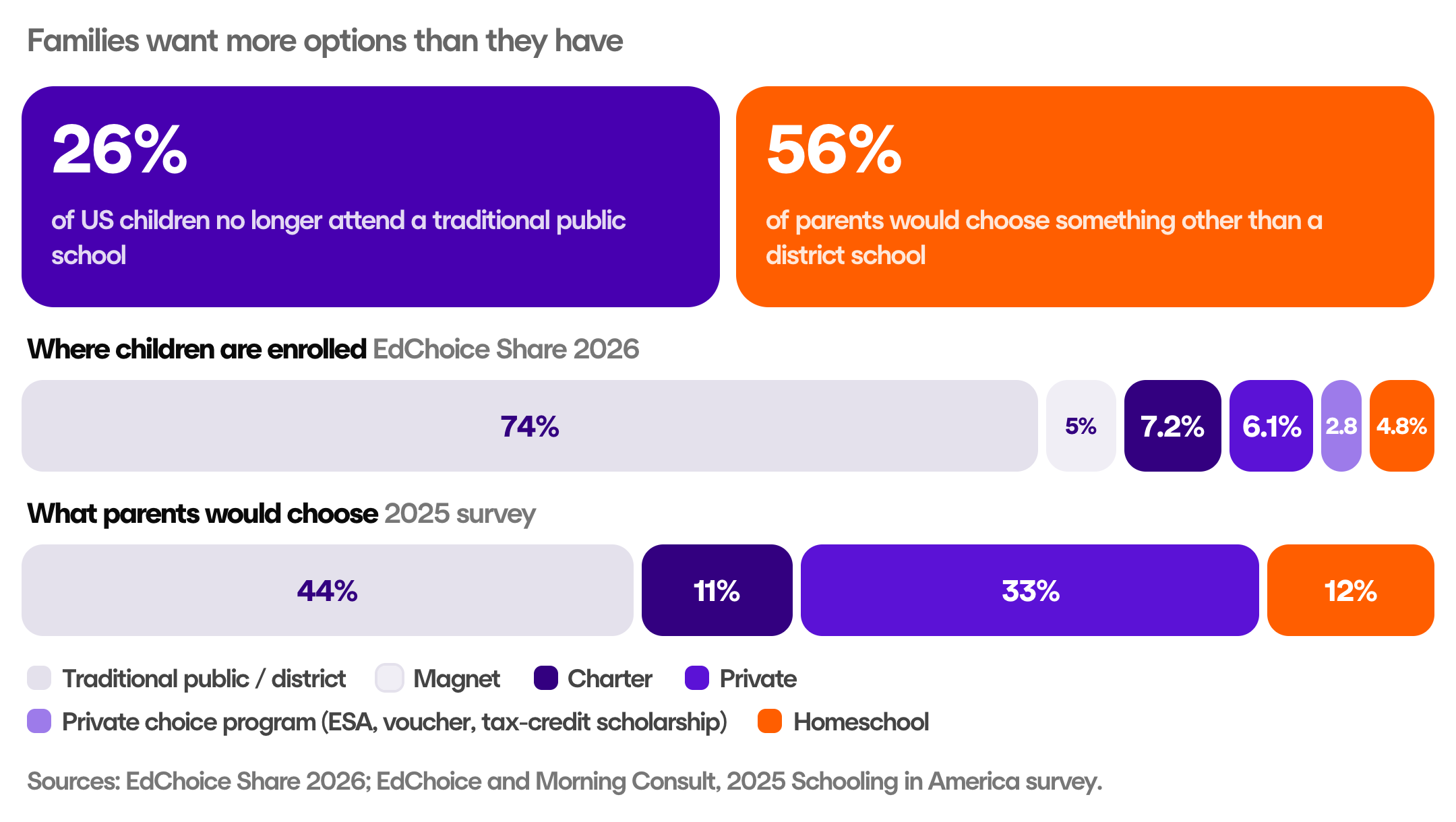
Models get better every few months, and industries are adopting them faster than any technology before. 39% of US adults used generative AI within two years, faster than PCs or the internet (St. Louis Fed, 2024). Timelines are creeping up on us, so the change needs to come now. Most schools are still working out how to catch students using it rather than realigning the school to make more sense for the reality we’re in. And parent satisfaction continues to drop: 26% of children no longer attend a traditional public school (EdChoice, 2026).
The Structure of School Hasn't Changed in a Century
Technology has been trying to change K-12 for decades, but there has been a failure to disrupt. That isn't because teachers don't care. Many of the best people in education are fighting the system they work in, but the system itself has poor incentive structures and therefore no reason to change. A district is funded whether its families are happy or not, and most unhappy families can only leave by moving house or paying tuition. In most of the economy, competition is what drives innovation but K-12 is one of the few places where that rule hasn't applied (yet).
Competition Gives Every School a Reason to Get Better
School choice brings competition to K-12 by letting families vote with their feet. District schools get a certain amount of funds per student across state, local and federal budgets. School choice means the money follows the child. A family can keep it at their local public school or take it to a private school, homeschool, microschool, a tutor, a class, a therapist and more. School choice isn’t about defunding public schools. We want public schools to adapt successfully. Public schools that adapt will bring in more families, and the funding that comes with them. School choice programs even allow families to purchase services at public schools as part of their rebundling. Education funding was always meant to serve the child. What changes with school choice is that every option now has a reason to get better and families aren't financially limited in accessing these options.
It's Happening: Up to $245B Is Already Available
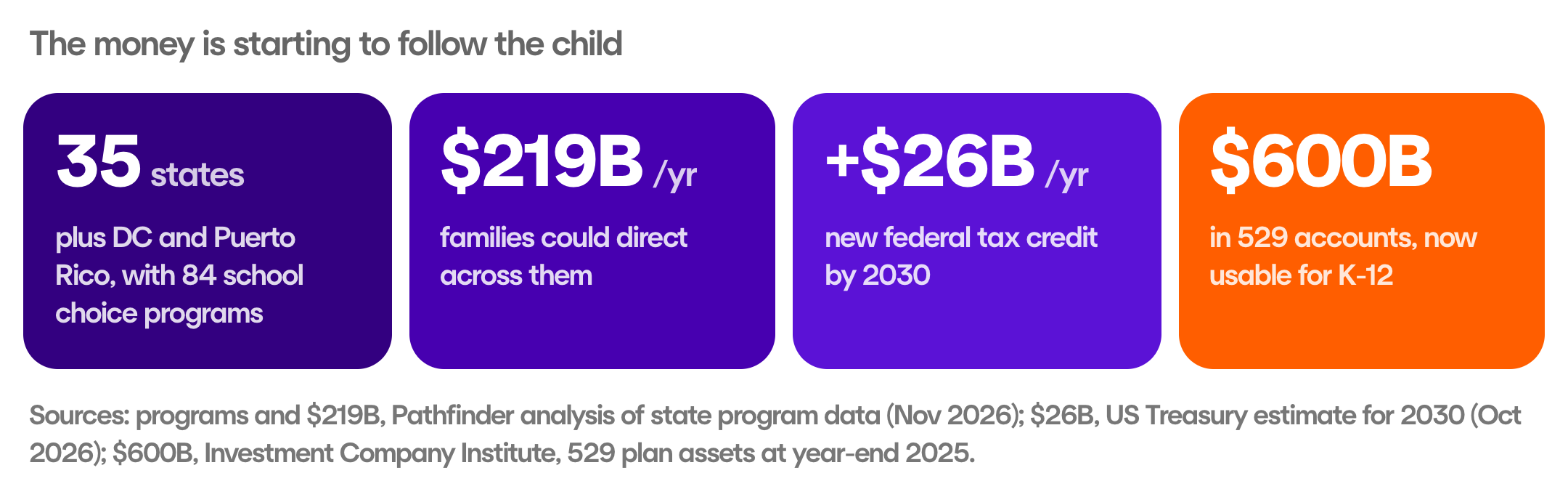
School choice used to be a fringe idea; before 2022, most programs were limited to students with disabilities or low-income families. In 2022 Arizona offered it to every family. Today, just 4 years later, 35 states, DC and Puerto Rico have 84 school choice programs that could let families direct up to $219B a year if all families opted in (program-by-program breakdown). Starting in January, a new federal program is estimated to add $26B more (by 2030) to both public and non-public school students. On top of this, the $600B saved in private 529 accounts can now also be used flexibly on K-12 spending (up to $20K/child/year) rather than just for college tuition.
Moving Money Is the Bottleneck
Choice only works if that money can move easily, conveniently and safely, and public money is hard to move. Olivia Ojeda told KOLD how hard that is for a parent.
In many programs, a family pays up front, files for reimbursement, and waits to learn whether the purchase counted. Program staff review transactions by hand. That leaves states three bad options: spot-check and accept some misuse, limit the options parents can spend on, or hire hundreds of auditors. One headline about misused funds can set a program back years, so some states limit what families can buy, and others don't launch at all. Limiting options isn’t enabling the power of school choice. It adds bureaucracy that slows down the innovation and adaptability of this new system. With Pathfinder, states no longer need to make these tradeoffs. Technology allows for scalable accountability across all potential purchases so parents can use their funds conveniently.
Where the money has started moving, new educational options have followed. Teachers are leaving the system to start something of their own: microschools, hybrid schools, co-ops, single classes. In the first two years of Arizona's universal ESA, the number of providers other than schools that families could pay nearly doubled, from just under 3,000 to nearly 5,600 (EdChoice, 2025).
A New Age of Schooling
Once the money follows the child, families can put together what works for that child. “School” as a bundled product - curriculum, social, childcare, legibility of skills, civic values - can now come apart. We bundled these because it was the cheapest way to coordinate. One building. One schedule. One administrator. One funding stream. That funding stream held the bundle together, so changing one part meant changing all of it. Today, 80% of Pathfinder’s users unbundle their “school” into multiple educational vendors.
Now that families can spend freely, the hard part becomes choosing. A parent can now pick from schools, microschools, tutors, therapists, classes, curriculum, and supplies, with little to compare them on and rules that differ by program. More options only help if parents can find the right ones for their child.
AI is starting to make it easier for parents to find the right options, fit them together, and keep track of what a child has actually learned, work that used to take an institution. Unbundling gives parents flexibility and low switching costs so they can find what works best for their child. And for the first time, the system has a way to change as fast as the world around it.
Pathfinder's Plan and Where We Are
Pathfinder helps families match their education funds to the right schools, teachers, extracurriculars and supplies. Families pay these vendors directly with their Pathfinder Card. Parents can check items against the program’s rules before they buy so they can purchase with confidence. And now we're building the tools that help parents find and compare what's out there, so the money goes to what's best for their child.
At our seed announcement, we laid out our 3-step plan:
- Open up choice funding for parents (ESAs, the new federal tax credit, 529s). Build out the easiest way for parents to be able to access their education funds. This also includes working with the state and federal government to remove blockers/caps/constraints on programs like ESAs.
- Help families navigate the options available. Become the go-to place to help families decide what to use their education funds for. Help them discover what's out there and ultimately piece together their dream education for their kids.
- Create more supply of options. School choice is inevitably becoming supply constrained. Private schools, microschools, clubs, transport, co-ops and pods are still popping up all over the country. It isn't and won't be fast enough to keep up with the growing demand. The educational entrepreneurs setting these up don't have the tools to simplify the process. By helping families navigate the options available, we will know where demand is underserved and can partner with local educators to build out more of these options.
The plan hasn't changed. Step one is now live with ~8% of Arizona’s ESA accounts and is growing virally. Step two has started. When families can spend easily and choose well, new providers can start, and society can legibly see whether the next generation is better prepared for the future.
Every industrial revolution has reshaped the education system. The Intelligence Age needs one that is personal, modular and adaptable. It's being built right now by parents, teachers, states and a new wave of companies. In this decade, we will raise our children in a way that feels familiar to the old but wildly different from today. Pathfinder is building the rails it runs on.
If you're obsessed with building the system that raises the next generation, we're hiring. Come build it with us: pathfindercard.com/join
Pathfinder is a financial technology company, not a bank. Pathfinder Education Visa® Charge Card ("Pathfinder Card") is issued by Column, N.A., Member FDIC, pursuant to a license from Visa U.S.A. Inc. The Pathfinder Card is only available to participants in education savings account programs in the following states: AZ.